_ed.png)


The Death of Poe: Medical Mystery or Violent Voter Fraud?
Updated: Dec 11, 2025
RORY-JAMES NORTH unpacks the murky truth of the death of horror fiction pioneer Edgar Allan Poe

The 3rd of October 1849. Baltimore. A man is brought to Washington Medical College wearing shabby clothing, reeking of alcohol and rambling incoherently.
Quickly identified as writer, poet and scholar Edgar Allan Poe, the man is shown to a special room reserved for those ill from intoxication.
Four days of suffering with hallucinations and delirium, detailed in a letter to Poe's aunt (and mother-in-law) as "converse with spectral and imaginary objects on the walls", ensured that Poe would never regain consciousness to reveal the truth of what happened to him. On the 7th October, aged 40, Poe died, his last words a weary and macabre plea; "Lord, help my poor soul!".
History has had no shortage of tortured artists. Vincent van Gogh, Sylvia Plath, Frida Kahlo, even Amy Winehouse are all considered tortured in one way or another. Whether that’s because of their mental health, their struggles with addiction or issues overcoming past injuries, these artists have all met unfortunate and often tragic ends. However, one tortured artist in particular managed to meet a demise as dark and mysterious as the marvels of gothic fiction he produced.
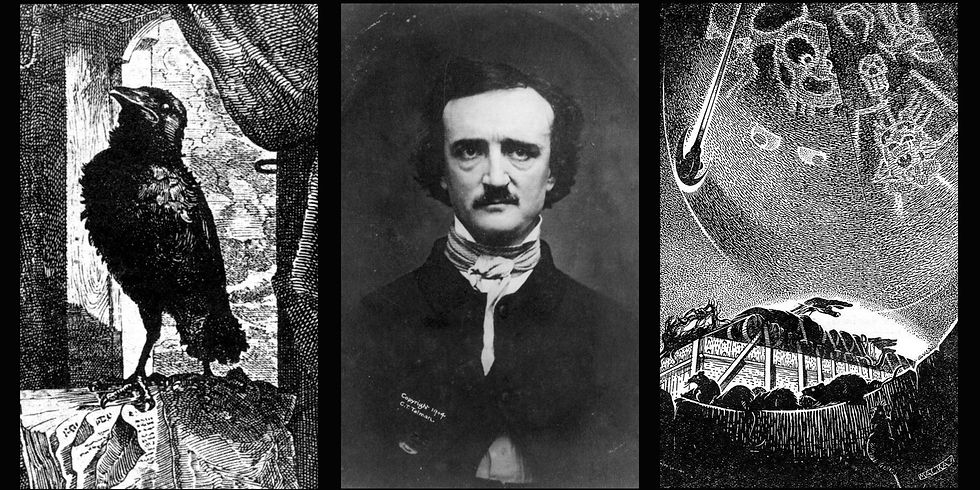
Edgar Allan Poe, author of The Raven and popular short stories such as The Tell-Tale Heart and The Pit and the Pendulum, seemed cursed by life-long misfortune. Suffering from the loss of his parents, his tumultuous school life not aided by his miserly uncle, the jilting of his first love, the death of his wife, Edgar Allan Poe is recorded to have died from ‘phrenitis’ or ‘congestion of the brain’. But what exactly does that mean? And why is the truth of this report still disputed by historians today?
Was Poe an alcoholic?
'Phrenitis', or 'congestion of the brain', has been used historically as a polite method to imply death relating to alcoholism or substance abuse. However, the intrigue of this diagnosis lies in Poe's history with addiction. The Edgar Allan Poe Society of Baltimore suggests that, from a strictly medical perspective, Poe could be considered an alcoholic.
However, they also claim that the implication Poe’s life was just one long drinking binge is “both unkind and inaccurate” (2009). While it's true that there were points in his life where Poe drank more than he should, these periods were often short, and followed by months or even years of refusing to touch a drop.
Poe writes in a letter to Dr. J. Evans Snodgrass in 1841 that “I am temperate even to rigor...But it is now four years since I have abandoned every kind of alcoholic drink”, (Ostrom, 1966). He explains that he possessed a “sensitive temperament”, which corresponds with a point from the curator of The Poe Museum, who states it has been “documented that after a glass of wine, he was staggering drunk” (Chris Semtner). While we can all relate to overindulgence in some capacity, it is alleged that Poe’s self-awareness when it came to drinking makes the official diagnosis of ‘phrenitis’ a curious one.
After all, what terrible thing must have happened for Poe to drink a sudden quantity he'd have surely known would kill him?
Beaten or alcohol poisoning?
Additional evidence of Poe's death being alcohol related came from an 1867 article in which biographer, E. Oakes Smith, claims that Poe was beaten and robbed after drinking.
She wrote: “At the instigation of a woman [...] who considered herself injured by him, Poe was cruelly beaten...by a ruffian who knew of no better mode of avenging said injuries”, and implied that this was the cause of the ‘brain fever’ that followed.
John Evangelist Walsh, a biographer almost 150 years later, developed this theory in his book Midnight Dreary; The Mysterious Death of Edgar Allan Poe. He wondered if it was possible that the brothers of Elmira Shelton (Poe's previous fiancé), having warned him against marrying their sister, poisoned him with alcohol and then beat him.
Whether they intended to kill hm is debatable, but so far neither theory discredits the other. Poe could have been amid a drinking spell and been beaten and robbed, and died from the combination of injuries. However, if he were poisoned by alcohol, it would make sense that it was wielded by someone of who knew of his sensitivity to it, right?
Cooped Up!
But what if Poe’s attackers (if indeed there were any) didn’t know of his intolerance to drink? What if they didn’t need to know, or simply didn’t care? At this point, it would be good to note that the pub whose gutter Poe was found collapsed in, was being used as a polling place, leading a number of historians to wonder if Poe may have been the victim of ‘cooping’, which was a violent form of voter fraud.
The gimmick was that a victim would be kidnapped by a gang and forced to vote multiple times in various disguises. As was customary, voters would be supplied with a tipple of alcohol after placing their vote, meaning that if Poe had been forced into this illicit activity, it would explain why he had drunk so much. He had been literally forced to! In the late 1870s, biographer J.H. Ingrahm received several letters explaining a theory to this effect.

Sick Unto Death
Despite the evidence implicating alcohol as a primary factor in Poe’s death, several other natural causes have been considered in the 175 years since it happened. These include epilepsy, syphilis, apoplexy, diabetes, cholera, enzyme deficiencies and even rabies!
But before we start frothing at the mouth, the most theorised natural cause for the writer’s death is a brain tumour. This is largely due to a discovery made 26 years after Poe had died, when his remains were exhumed to be reburied with a suitable monument.
When attempting to move his coffin, the box split, and Poe’s remains were spilled. It has been noted that a mass could be heard rolling around the poet’s skull, leading some to believe that this was a tumour, calcified as his body decayed.
The most fascinating thing about the mysterious and macabre end to the master of Gothic fiction, is that no one theory rules out another, so whichever theory you choose to believe, you could be equally right and wrong. The point is, we will never truly know what caused such a legendary storyteller to end up in that gutter on that fateful day. But what is certain is his works and genius withstand the test of time, as the most troubled artists often produce the finest work.

Written by RORY-JAMES NORTH, (English Literature student, University of Chester, UK)


Comments